
Drift (Part II) - GPS
Where are you going? What or Who is Guiding you there?

There are two ways in which the human machine goes wrong. One is when human individuals drift apart from one another, or else collide with one another and do one another damage, by cheating or bullying. The other is when things go wrong inside the individual—when the different parts of him (his different faculties and desires and so on) either drift apart or interfere with one another. You can get the idea plain if you think of us as a fleet of ships sailing in formation. The voyage will be a success only, in the first place, if the ships do not collide and get in one another’s way; and, secondly, if each ship is seaworthy and has her engines in good order.
As I was reading this for the second time in my life (so really, the first time), I was inside the flagship of a carrier strike group - a small part of a fleet - transiting from San Diego on the beginning of a deployment that almost circumnavigated the earth. USS John C. Stennis would end its deployment in May 2019 in Norfolk, VA having begun it in Bremerton, WA the previous October.
It was October 18, 2018 that I walked into Bay Books in Coronado, California and encountered “Mere Christianity” almost immediately, cover facing out on the first shelf that I saw. The preceding two years had been a humbling process for someone who had suffered from a PHD his entire life. No, I had not earned a Doctor of Philosophy degree. I had Prideful Heart Disease or you could even say I was a self-taught Doctor of Pharisaism. During my “get well” tour assigned to this carrier’s strike group staff, as I plotted my next career and life moves, I took advantage of the extra time to read and read and read. Many of those readings became Taps of the Shepherd’s Crook (TM) that in retrospect led me to this very moment. Some of the most significant of those TSCs included “Man’s Search for Meaning” by Viktor Frankl, “This is Water” by David Foster Wallace, “Cargo Cult Science” by Richard Feynman, “Middlemarch” by George Eliot, “A Vietnam Experience” by VADM James Stockdale, and “A Field Guide to Understanding Human Error” by Sidney Dekker to name a few. Among those six authors there was not a single Christian.
I picked up the book to read again without a moment’s hesitation. I won’t say it was a “tolle lege” moment like Augustine’s in garden, but there was a sense that it was finally time. I say “finally time” because since the first time I read it circa 2000, I had re-encountered and put off reading it again in browsing the shelves of numerous bookstores in and around Washington D.C., San Diego, and Newport Rhode Island over the course of the next 18 years. I read it the first time at the recommendation of then-Lieutenant Commander Bryan McGrath, Executive Officer of USS PRINCETON (CG 59). Honor and Glory! I think I was merely a professing agnostic at the time. He seeing that I was somewhat of a literary bent might thought I might appreciate Lewis’ background and ability to turn a phrase or two aside in addition to the powerful case he makes in this famous work.
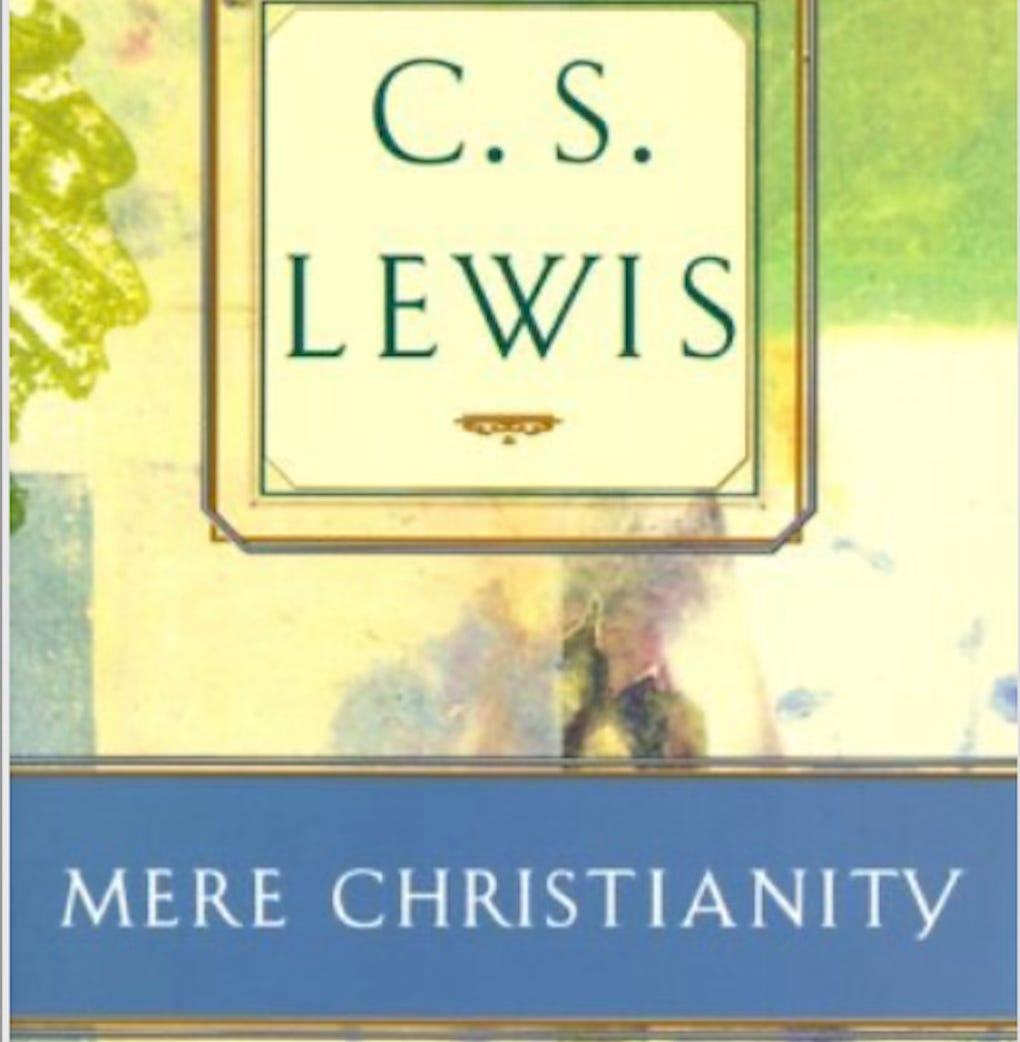
This version of cover rings a bell. I read it out of admiration and loyalty to Bryan, but it moved the spiritual needle of my heart not one micrometer. But a seed was planted. How many times had I passed it in the ensuing years in Kramerbooks alone in the wee hours of a Friday or Saturday night! Back in the day they were open 24 hours on those nights.
This second reading was the coup de grace. Was there a moment moment? It is tough to say, I think it happened over the course of that first few weeks of deployment as I read this and a few others of his works simultaneously. His essay “Man or Rabbit” in “God in the Dock” was also one another impactful blow. I shall write about that another time.
Lewis’ illustration at the beginning of Book Three* “The Three Parts of Morality” looms large in my mind. If you’ve read Drift (Part I) and Standards, you’ll appreciate where my mind was by this point. I understood that I had no standard (or voyage plan) by which I was navigating my life and that my experience in command revealed that what I had ignored that lack for too long. There is a True Standard and I adrift far from it. I cannot even say that I was driving away from it. Rather I had allowed myself to get caught up by the wind and the current of what the world values but had been under the illusion that I was driving. The nearest hazard to navigation of my life was the navigator…me.
There are two ways in which the human machine goes wrong. One is when human individuals drift apart from one another, or else collide with one another and do one another damage, by cheating or bullying. The other is when things go wrong inside the individual—when the different parts of him (his different faculties and desires and so on) either drift apart or interfere with one another.
Or to more fully use his illustration, the nearest hazard to navigation was my own ship, me. I was neither seaworthy nor were my engines in good order. I’m going to let Lewis mostly speak for himself.
The voyage will be a success only, in the first place, if the ships do not collide and get in one another’s way; and, secondly, if each ship is seaworthy and has her engines in good order. As a matter of fact, you cannot have either of these two things without the other. If the ships keep on having collisions they will not remain seaworthy very long. On the other hand, if their steering gears are out of order they will not be able to avoid collisions. Or, if you like, think of humanity as a band playing a tune. To get a good result, you need two things. Each player’s individual instrument must be in tune and also each must come in at the right moment so as to combine with all the others. But there is one thing we have not yet taken into account. We have not asked where the fleet is trying to get to, or what piece of music the band is trying to play. The instruments might be all in tune and might all come in at the right moment, but even so the performance would not be a success if they had been engaged to provide dance music and actually played nothing but Dead Marches. And however well the fleet sailed, its voyage would be a failure if it were meant to reach New York and actually arrived at Calcutta.
Steaming across the Pacific in flotilla of an aircraft carrier + airwing and several escorts probably helped this illustration be most impactful to me.
But there is one thing we have not yet taken into account. We have not asked where the fleet is trying to get to….And however well the fleet sailed, its voyage would be a failure if it were meant to reach New York and actually arrived at Calcutta.
Please don’t try to draw conclusions as to what New York or Calcutta represents here.
It occurred to me beyond whatever might happen if I “got well” in the CSG Ops job (which I absolutely LOVED and did well in, if you must know!), I was not headed toward the right destination as father, as a husband, a son, or as a human being.
Morality, then, seems to be concerned with three things. Firstly, with fair play and harmony between individuals. Secondly, with what might be called tidying up or harmonising the things inside each individual. Thirdly, with the general purpose of human life as a whole: what man was made for: what course the whole fleet ought to be on: what tune the conductor of the band wants it to play.
Later on I would come to appreciate that the answer to what course would be provided in Bible verses like this one from Psalm 73:
26 My flesh and my heart may fail,
but God is the strength of my heart and my portion forever.
27 For behold, those who are far from you shall perish;
you put an end to everyone who is unfaithful to you.
28 But for me it is good to be near God;
More Lewis:
You may have noticed that modern people are nearly always thinking about the first thing and forgetting the other two. When people say in the newspapers that we are striving for Christian moral standards, they usually mean that we are striving for kindness and fair play between nations, and classes, and individuals; that is, they are thinking only of the first thing. When a man says about something he wants to do, ‘It can’t be wrong because it doesn’t do anyone else any harm,’ he is thinking only of the first thing. He is thinking it does not matter what his ship is like inside provided that he does not run into the next ship. And it is quite natural, when we start thinking about morality, to begin with the first thing, with social relations. For one thing, the results of bad morality in that sphere are so obvious and press on us every day: war and poverty and graft and lies and shoddy work. And also, as long as you stick to the first thing, there is very little disagreement about morality.
I was reminded of how much of a free-rider I had been in my life. What do I mean by that? Even in my most strident atheism, I had very much appreciated there were a lot of people who truly lived out their professed Christianity. I also truly believed what our nation’s second President asserted in a letter to the Massachusetts Militia dated 11 October 1798
Because We have no Government armed with Power capable of contending with human Passions unbridled by morality and Religion. Avarice, Ambition, Revenge or Gallantry, would break the strongest Cords of our Constitution as a Whale goes through a Net. Our Constitution was made only for a moral and religious people. It is wholly inadequate to the government of any other.
I was very thankful that so many others’ ships and engines were in good working order, yet I hadn’t thought very much about the cognitive dissonance between valuing the outcomes they’d produced and naively dismissing the source of their guidance.
Almost all people at all times have agreed (in theory) that human beings ought to be honest and kind and helpful to one another. But though it is natural to begin with all that, if our thinking about morality stops there, we might just as well not have thought at all. Unless we go on to the second thing—the tidying up inside each human being—we are only deceiving ourselves.
Mark 7:20–23
20 And he said, “What comes out of a person is what defiles him. 21 For from within, out of the heart of man, come evil thoughts, sexual immorality, theft, murder, adultery, 22 coveting, wickedness, deceit, sensuality, envy, slander, pride, foolishness. 23 All these evil things come from within, and they defile a person.”
What is the good of telling the ships how to steer so as to avoid collisions if, in fact, they are such crazy old tubs that they cannot be steered at all? What is the good of drawing up, on paper, rules for social behaviour, if we know that, in fact, our greed, cowardice, ill temper, and self-conceit are going to prevent us from keeping them? I do not mean for a moment that we ought not to think, and think hard, about improvements in our social and economic system. What I do mean is that all that thinking will be mere moonshine unless we realise that nothing but the courage and unselfishness of individuals is ever going to make any system work properly.
All the moral ideals in the world mean nothing if we deny the truth about ourselves, that we each have our own misdirected tendencies. I recall talking to my crews about sexual harassment and assault prevention. I’d challenge them, saying “I can see in many of your eyes that you think I am talking about the person next to you, that you are not capable of, given the right circumstances, these behaviors we are discussing. You all know I am not a believer, but I did grow up in Alabama and I remember hearing something in the Bible about “pride goes before a fall (sic).”
Proverbs 16:18
18 Pride goes before destruction,
and a haughty spirit before a fall.
Then I would tell them about the Capos (or Kapos) Frankl talked about in “Man’s Search for Meaning.” Lewis echoes Adams below:
You cannot make men good by law: and without good men you cannot have a good society. That is why we must go on to think of the second thing: of morality inside the individual.
How to keep from being a crazy old tub.
But I do not think we can stop there either. We are now getting to the point at which different beliefs about the universe lead to different behaviour. And it would seem, at first sight, very sensible to stop before we got there, and just carry on with those parts of morality that all sensible people agree about. But can we? Remember that religion involves a series of statements about facts, which must be either true or false. If they are true, one set of conclusions will follow about the right sailing of the human fleet: if they are false, quite a different set. For example, let us go back to the man who says that a thing cannot be wrong unless it hurts some other human being. He quite understands that he must not damage the other ships in the convoy, but he honestly thinks that what he does to his own ship is simply his own business. But does it not make a great difference whether his ship is his own property or not? Does it not make a great difference whether I am, so to speak, the landlord of my own mind and body, or only a tenant, responsible to the real landlord? If somebody else made me, for his own purposes, then I shall have a lot of duties which I should not have if I simply belonged to myself.
I thought the same about any ship I was ever on. We often described our individual investment in the ship to which we are assigned as “ownership.” Literally treating it is if it were our own prized possessions. As I was retiring, ownership was added to the original Six Watchstanding Principles. I wish they had instead used stewardship, which is taking care of a thing as if you owned it but knowing that the benefits of your efforts will accrue to someone else who comes after you or taking care of something on behalf of someone else.
Again, Christianity asserts that every individual human being is going to live for ever, and this must be either true or false. Now there are a good many things which would not be worth bothering about if I were going to live only seventy years, but which I had better bother about very seriously if I am going to live for ever. Perhaps my bad temper or my jealousy are gradually getting worse—so gradually that the increase in seventy years will not be very noticeable. But it might be absolute hell in a million years: in fact, if Christianity is true, Hell is the precisely correct technical term for what it would be. And immortality makes this other difference, which, by the by, has a connection with the difference between totalitarianism and democracy. If individuals live only seventy years, then a state, or a nation, or a civilisation, which may last for a thousand years, is more important than an individual. But if Christianity is true, then the individual is not only more important but incomparably more important, for he is everlasting and the life of a state or a civilisation, compared with his, is only a moment. It seems, then, that if we are to think about morality, we must think of all three departments: relations between man and man: things inside each man: and relations between man and the power that made him. We can all co-operate in the first one. Disagreements begin with the second and become more serious with the third. It is dealing with the third that the main differences between Christian and non-Christian morality come out.
He’d gotten my attention with the ship illustration and stopped me in my tracks with the question of what was truly important if I were truly going to live forever. I realized that I had dismissed such a possibility out of hand previously. I guess when everything goes your way for so long, you don’t need to consider such things. You are the master of your own universe.
If morality was indeed concerned with three things: 1) harmony between individuals, 2) internal harmony, and 3) what was I made for?, I was indeed the nearest hazard to navigation. I may not have collided with other people in the most catastrophic sense, but not having a course I was trying to drive to, especially when others did, I was letting the wind and current push me to and fro and making it harder for others to stay their own course. I was learning that my internal machinery was not operating as well as I would have liked. I had not operated very well as a commanding officer nor as a husband, father, son, and friend.
I had no source of guidance outside myself and had no process of taking fixes to determine where I was supposed to be or where I was in relation to that “supposed to be.” I lacked a moral GPS and been living by seaman’s eye. I don’t really mean Global Positioning System in this sense, but something like it for the moral plane of existence. I had been more or less navigating through life based on inertia or a GPS that stood for Gain, Pride, Selfishness. The Navy had provided a great sense or consistent reorientation as the institutional outside force against professional drift. But what about when the Navy was no longer in the picture? I had been accumulating errors, internal disharmony over the course of my life. To quote again what started this post
the different parts of [me] ([my] different faculties and desires and so on) were drif[ting] apart or interfer[ing] with one another.
There is such a thing as an Inertial Navigation System, which is basically gyroscopes + accelerometers that allow for precision navigation in aviation and maritime applications (planes and ships). Do me and you a favor. Watch this.
Then this.
Otherwise the following will make less sense. :)
I have come to think that people are like very well designed Inertial Navigation Systems that have had “dodgy bearings or wobbly weights” introduced since Genesis 3. These dodgy bearings and wobbly weights (wrongly oriented internal faculties and desires) result in real wander. Uncorrected real wander can lead to accumulated error.
Disclaimer. The most modern INS are not nearly no sensitive and really gifted engineers have incorporated many ways to correct for these errors.
There are numerous error sources that influence the accuracy of a stand-alone inertial navigation system, including gyro drift, gyro scale factor, accelerometer bias, accelerometer scale factor, sensor assembly alignment, computational errors, and initial condition. Unfortunately, if uncorrected, these errors can increase monotonically with time, possibly becoming significant for a long trip. However, a typical [state of the art] inertial navigation system with no error corrections can achieve an error of less than 1 nmiles in 1000 nmiles.
Of course, less than 1nm would be still be a BIG deal when in restricted waters approaching one’s destination.
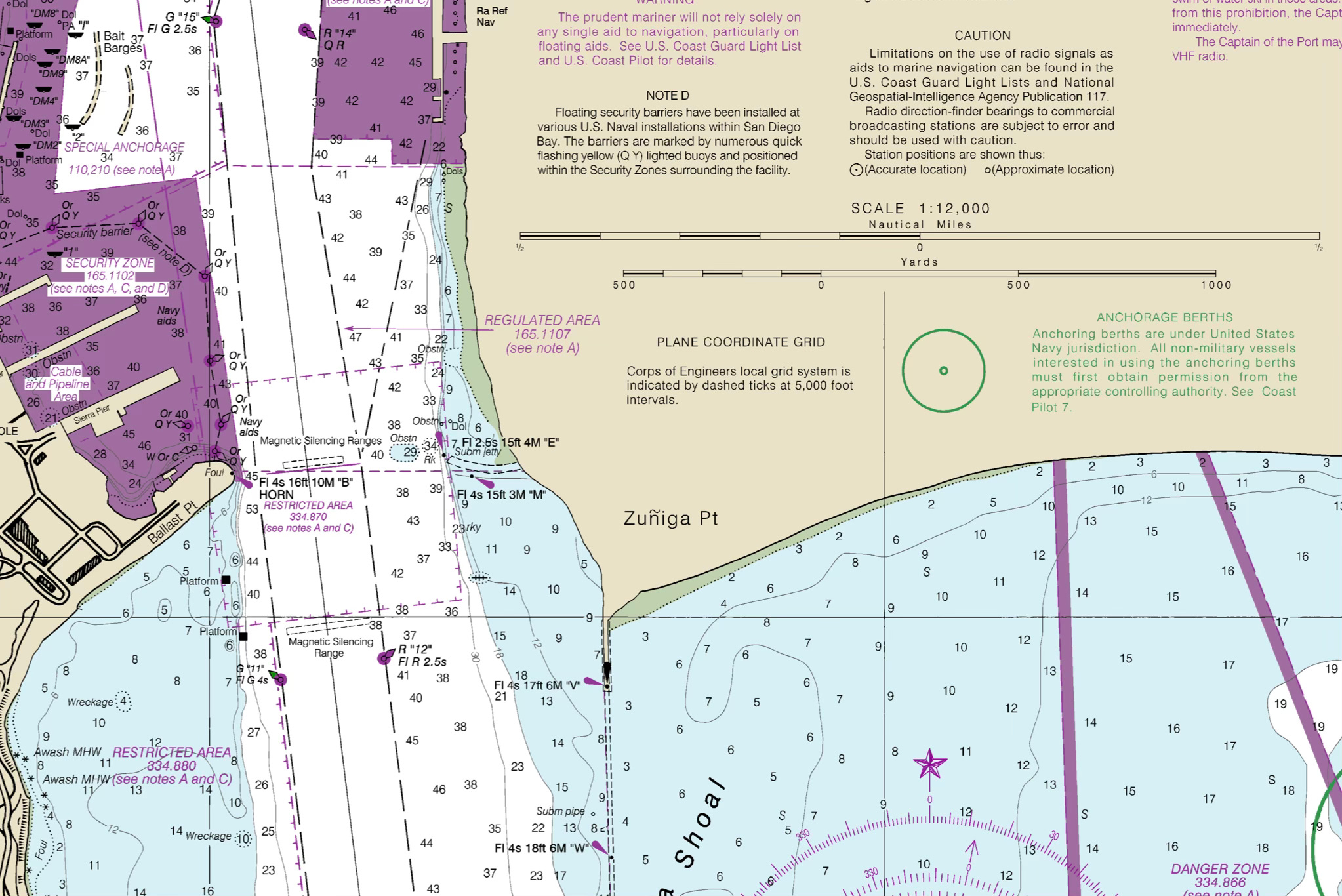
The north/sound channels into San Diego are about 250 yards wide, well within the margin of error.
Back to GPS, the Global Positioning System is used to help correct for those errors that accumulate in INS (generally speaking…I know there’s a lot more technical nuance here).
It was in these moments the late evenings after the daily battle rhythm of the Commander’s Update Brief, Current OPS, Future OPS, Future Plans, observing Flight Operations, writing DIMS, the occasional crisis action planning drills I pondered this analogy.
I was this human internal navigation system with a lifetime of dodgy bearing and wobbly weight induced true wander…error that had been uncorrected by the real GPS.
God’s Plan for Salvation.
Romans 3:23
23 for all have sinned and fall short of the glory of God,
Romans 6:23
23 For the wages of sin is death, but the free gift of God is eternal life in Christ Jesus our Lord.
I was missing the mark and going to get to the wrong destination.
John 1:14
14 And the Word became flesh and dwelt among us, and we have seen his glory, glory as of the only Son from the Father, full of grace and truth.
2 Corinthians 5:21
21 For our sake he made him to be sin who knew no sin, so that in him we might become the righteousness of God.
1 Corinthians 15:3
3 For I delivered to you as of first importance what I also received: that Christ died for our sins in accordance with the Scriptures,
That great and grand ship designer and builder, God the Father, sent his son to bear the brunt of our missing the mark.
Acts 16:30–31
30 Then he brought them out and said, “Sirs, what must I do to be saved?” 31 And they said, “Believe in the Lord Jesus, and you will be saved, you and your household.”
John 3:16–18 (For God So Loved the World)
16 “For God so loved the world, that he gave his only Son, that whoever believes in him should not perish but have eternal life. 17 For God did not send his Son into the world to condemn the world, but in order that the world might be saved through him. 18 Whoever believes in him is not condemned, but whoever does not believe is condemned already, because he has not believed in the name of the only Son of God.
Ephesians 2:8–9
8 For by grace you have been saved through faith. And this is not your own doing; it is the gift of God, 9 not a result of works, so that no one may boast.
John 14:6
6 Jesus said to him, “I am the way, and the truth, and the life. No one comes to the Father except through me.
Acts 4:12
12 And there is salvation in no one else, for there is no other name under heaven given among men by which we must be saved.”
In those moments in late October, Jesus took tactical control of my life. “Follow me.” (Matt 9:9). He is the course to the right destination. There is no other.
John 14:15–16; 26 (Jesus Promises the Holy Spirit)
15 “If you love me, you will keep my commandments. 16 And I will ask the Father, and he will give you another Helper, to be with you forever,
26 But the Helper, the Holy Spirit, whom the Father will send in my name, he will teach you all things and bring to your remembrance all that I have said to you.
2 Corinthians 3:18
18 And we all, with unveiled face, beholding the glory of the Lord, are being transformed into the same image from one degree of glory to another. For this comes from the Lord who is the Spirit.
Not only does he provide us the navigational track in Jesus Christ whom he sent to save us from our drift. He sent the Holy Spirit to overhaul us little by little from one degree of glory to another, transforming those dodgy spiriting bearings and wobbly spiritual weights (wrongly oriented internal faculties and desires), so that we can be in better harmony with other individuals, 2) have internal harmony, and 3) become what was we were made for.
Humbly I think there is evidence of his goodness. A shipmate who watched up close this process really take root, sent me this recently:
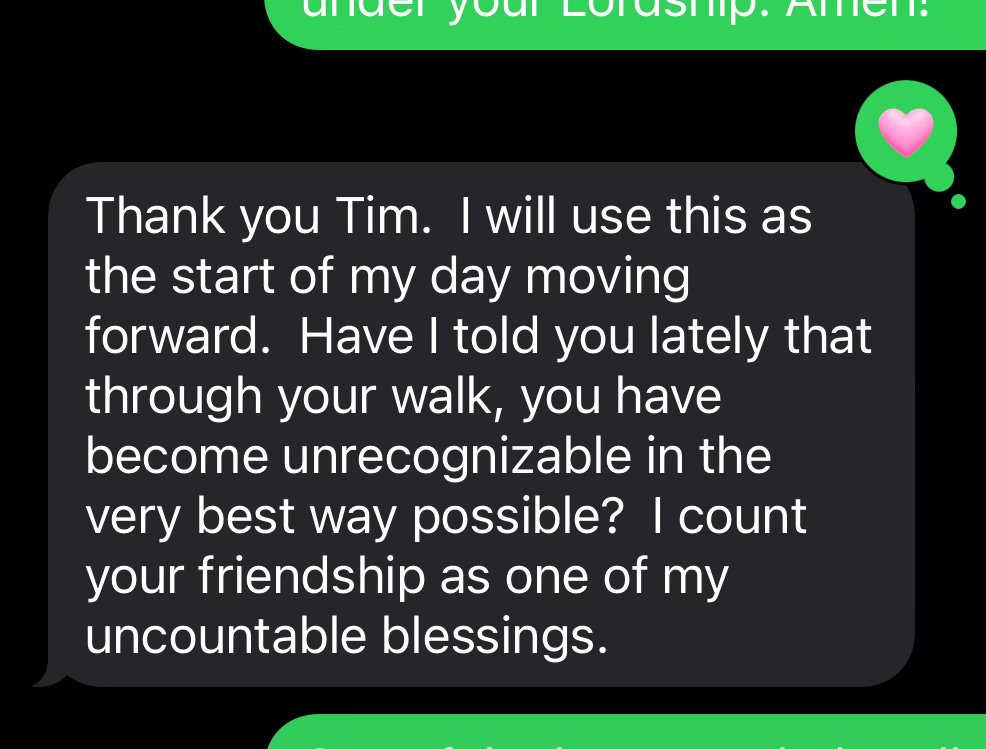
All glory be to God. He did this. I just surrendered my pride.
Good read. Love the deeper insight to the Navy, INS and gyroscopes and the connection to Mere Christianity. Lots of good bits to ponder
"You have become unrecognizable in the very best way possible." What a wonderful thing to say and to hear about oneself. Thank you for this beautiful morning read.